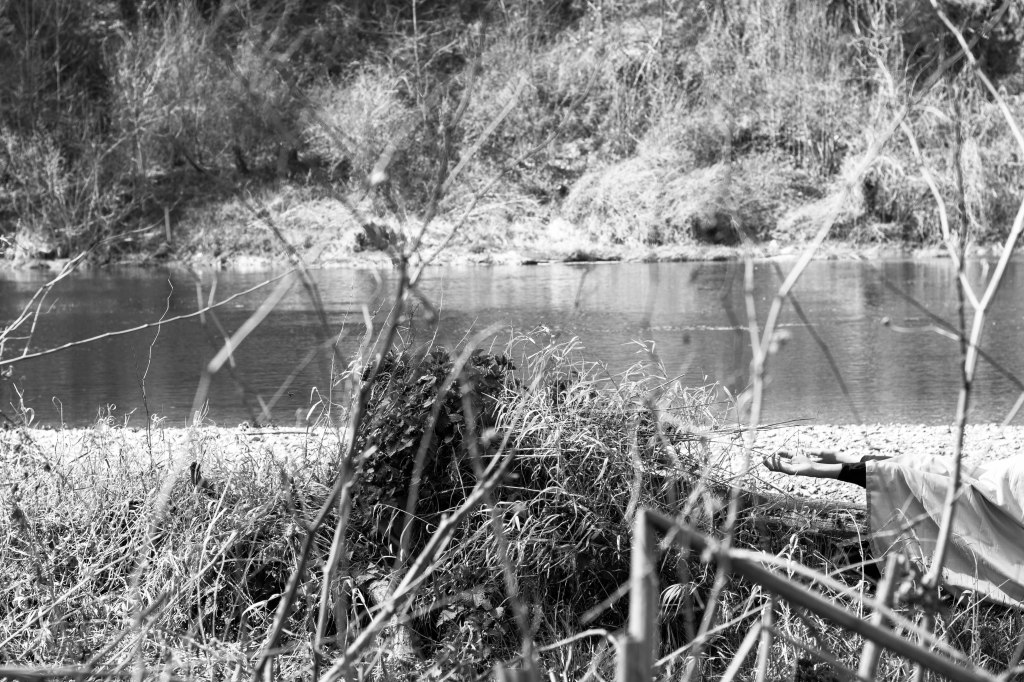


To Be a Landscape | To Dwell the Invisible (2021) explores the complex relationship between the human body and its environment, particularly focusing on themes of disappearance, transformation through the fusion of the human body and nature, and the escape from the social self. Created in the context of the global lockdown of 2020, this project questions the place of the human being within nature and the landscape, at a time when bodies have disappeared from public spaces. It invites reflection on how our bodies, both physical and social, can escape social gazes while finding their place in the natural world.
In this project, the concept of the body-screen, as defined by Nadia Vadori-Gauthier, is central to the reflection. The body becomes a medium for social projections and expectations. However, in this series, a body covered in a white fabric blurs this function of projection. This fabric facilitates the escape of the social self while maintaining the physical presence of the body. It thus transforms the body into an entity that is both visible and invisible: visible in its physical presence, but invisible as it escapes external judgments and projections. This transformation questions the existence of the body independent of social gazes and its integration into the natural landscape.
Thus, To Be a Landscape | To Dwell the Invisible questions the boundaries between the human body and nature. The project explores the idea of a possible fusion between these two entities. In this dialogue between disappearance and transformation, it seeks to conceive escape not as a flight, but as a redefinition of how the human body coexists with its surroundings.
This series highlights the tension between presence and erasure, between social visibility and chosen invisibility. It raises an essential question: how do we perceive our bodies in relation to the natural and social world? Can we fully exist in the world if our bodies escape and merge into the landscape, becoming invisible while remaining present?


Camera: Nikon F-501, 18-70mm // Canon 1100D, 50mm.
Film: ILFORD PAN 400 ASA.
Creation date: March 2021.
Location: Saint-Etienne, France.
This series was exhibited as part of the « Image Corporelle » exhibition, within the Jaou Tunis festival, organized by the Kamel Lazaar Foundation in Tunis, Tunisia 2022.

 Aya Chriki